EPISODE / 01
Onion preparation
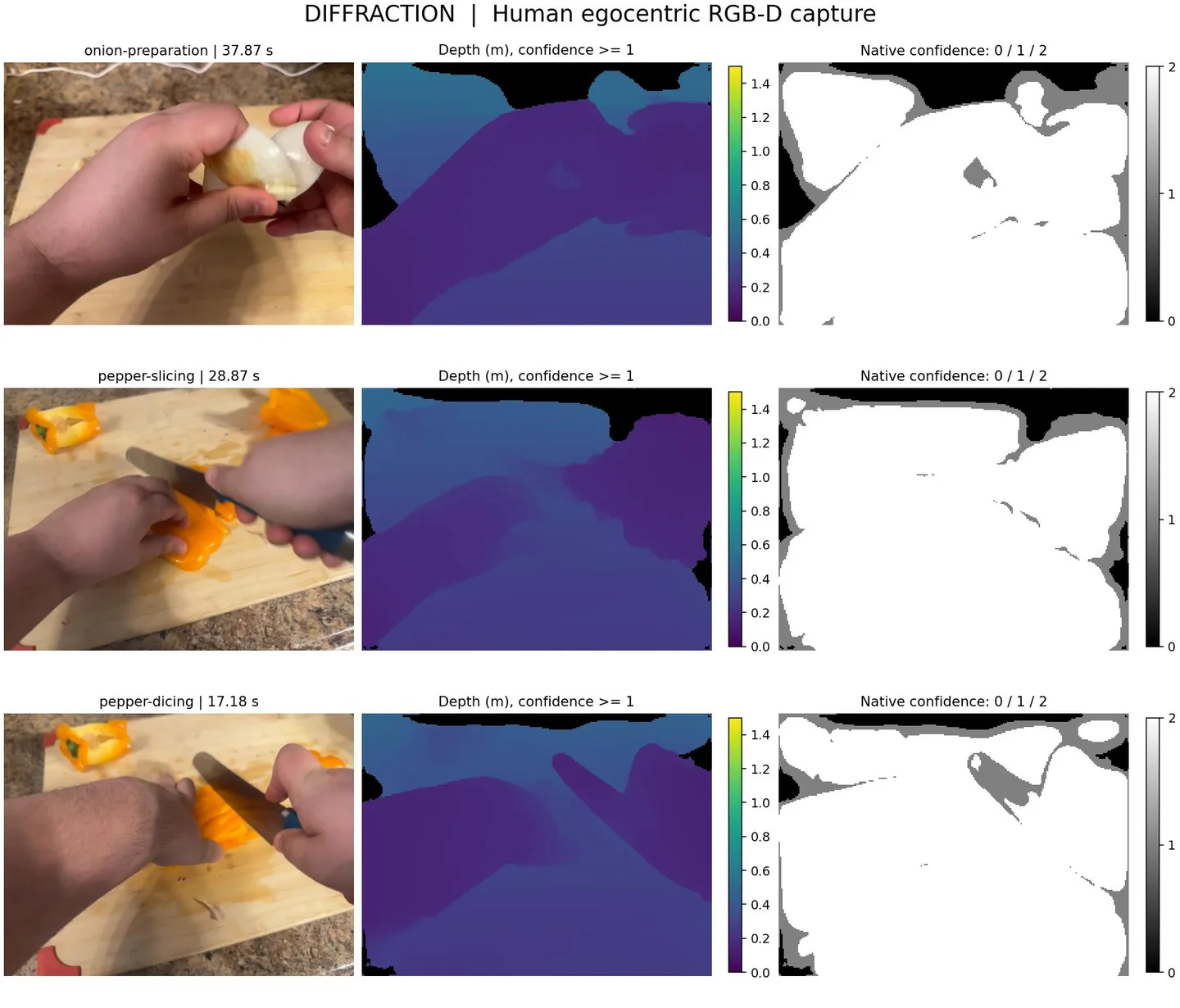
Preparing and peeling an onion on a cutting board.
75.73 s4,543 frames
 Diffraction
 Inside the release · RGB-D · Human observation
Three everyday manipulation recordings captured with Stray Scanner on a LiDAR-equipped iPhone. Explore the native RGB-D, inspect the estimates, and understand the limits before using them.
 Download on Hugging Face
Public release · CC BY 4.0 · 2026-09-08
3
Recordings
167.85 s
Total duration
10,070
Native RGB frames
RGB-D
Primary capture
The capture sequence
EPISODE / 01
Preparing and peeling an onion on a cutting board.
EPISODE / 02
Preparing and slicing a bell pepper with a kitchen knife.
EPISODE / 03
Dicing bell pepper strips on a cutting board.
Participant count, exact device model, app version and independent session identity were not supplied in the release. These closely related kitchen recordings do not establish cross-person or cross-environment generalization.
Read the evidence correctly
Native capture
Native 1920 × 1440 RGB video, 256 × 192 metric depth and confidence, per-frame calibration and raw device IMU. IMU acceleration units require capture-version verification; device motion is distinct from wrist motion.
Estimated channels
Camera pose comes from device visual-inertial odometry. Hand pose, palm orientation, object tracks and contact are estimates. Missingness and identity ambiguity are documented; confidence scores are not calibrated error probabilities.
Outside this release
No measured robot commands, force or tactile data. No independent annotation accuracy benchmark or demonstrated robot-policy improvement. The recordings share one conservative session group; there is no train/test benchmark.
Begin with a technical evaluation
Packaged validation checks cover reader behavior, geometry, file hashes and missing-value semantics. They establish packaging integrity, not label accuracy. The sample’s low-resolution depth can miss fingers, thin tool edges and occlusion boundaries.
Read the full quality report ↗Use the portable reader included with the release. These commands select the documented revision so you can reproduce this page’s reference package.
pip install huggingface_hub
hf download diffracting/egocentric-kitchen-sample --repo-type dataset --revision 75ccd3fc9fbb78be56029539ab1ebf9fb1f3e2f4 --local-dir diffraction-sample
cd diffraction-sample
pip install -r requirements.txt
python observation_reader.py .
See the Hugging Face dataset card for the latest files and usage examples. Smaller browser previews are distinct from the training videos in the download.
This release is labeled CC BY 4.0. Follow the license terms and attribute Diffraction Egocentric Kitchen Capture Sample (2026), the dataset URL and the revision used. This page summarizes revision 75ccd3fc9fbb; consult its documentation for the full schema and limitations.
Continue exploring
Take the next step
Use what you learn from the sample to specify the activities, signals and acceptance checks your own project needs.
Build your brief with the buyer’s guide →