01 · Controlled
POD capture
Structured tasks in a repeatable environment with one egocentric camera and zero to four exocentric views, configured around the buyer's measurement needs.
 Diffraction
 Diffraction designs and operates human-demonstration capture for robotics and physical AI. Start with one egocentric stream, add up to four exocentric cameras and wrist IMUs when the spec calls for them, then scale through a trained operator network.

One ego view. Zero to four exo views. The hardware follows the question.
 Diffraction on Hugging Face
Explore Diffraction’s profile on the Hugging Face Hub. Follow our work and keep up with the datasets we share.
Explore on Hugging Face Browse our public dataset sample library Hugging Face diffracting ↗The task decides whether control, environmental diversity, or embodiment access matters most. Collection can use one mode or combine them.
Structured tasks in a repeatable environment with one egocentric camera and zero to four exocentric views, configured around the buyer's measurement needs.
Activate trained people across real homes, workshops, and everyday environments when diversity matters more than a single controlled room.
We are building a network of operators with access to arms so future projects can collect teleoperated demonstrations for ACT and related policy-training workflows.
More hardware is not automatically better data. We choose each view and sensor based on the signal the model actually needs.
Use the ego stream alone or add the room coverage the task needs. Camera count follows the spec rather than a fixed bundle.
Add wrist-worn inertial measurements when the project needs motion channels beyond visual hand and body tracking.
Flash/audio sync and calibrated cameras are supported today; higher-fidelity hardware sync and machine-vision rigs can be scoped as the capture stack expands.
iPhone/Record3D and standard video ingest exist now. Additional ego devices, depth sensors, IMUs, and robot embodiments are integrated when the signal justifies them.
The processing stack can add geometry, hands, bodies, objects, contact, action, and quality signals. Every delivery distinguishes measured channels from estimates so buyers know what they can trust.
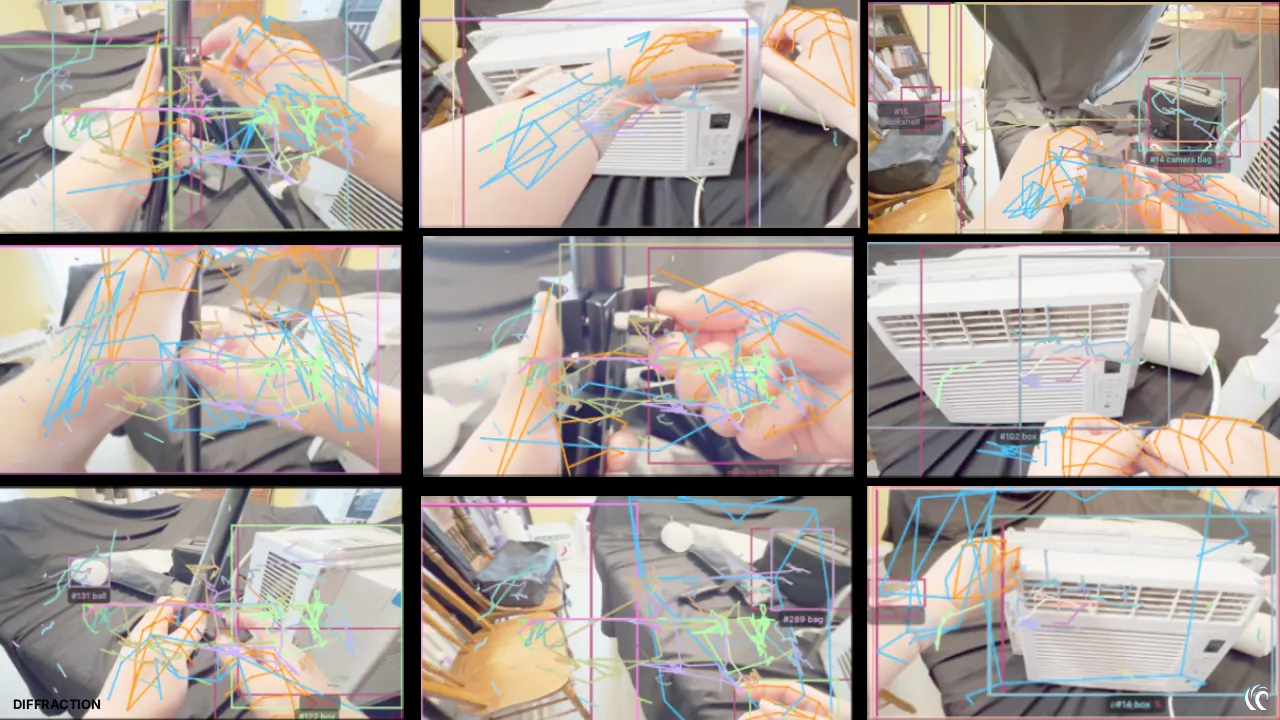
The brief stays attached to the work from operator instructions through QA and the final dataset card.
Define tasks, environments, viewpoints, hardware, participant profile, signals, acceptance thresholds, and delivery schema with your team.
Use the Columbus POD, activate distributed operators, or combine controlled and in-the-wild collection for the coverage the policy needs.
Operators receive task protocols, equipment guidance, consent terms, and quality criteria before a session begins.
The pipeline preserves source media, enriches available signals, distinguishes measured from estimated channels, and scores the asset against the brief.
Ship the agreed format with manifests, dataset cards, licensing, provenance, known limitations, and a clear record of what was—and was not—measured.
Preserved source media and normalized camera streams, organized by session and task.
Hand/body pose, detections, tracks, contact, camera pose, depth, IMU, and action channels where the capture and brief support them.
WebDataset, RLDS, and LeRobot/GR00T-compatible layouts scoped to the buyer's training stack.
Acceptance results, measured-versus-estimated declarations, licensing, limitations, and signed asset provenance.
The software loop already exports LeRobot-compatible episodes and can train and evaluate ACT policies. The next scale layer is physical access: operators who own arms, teleoperate tasks, and create diverse demonstrations outside a single centralized lab.
This track is in buildout, not a claim of fleet-scale availability today. We are recruiting arm owners and scoping pilot collections with teams that want to help define the protocol.
Discuss an ACT pilot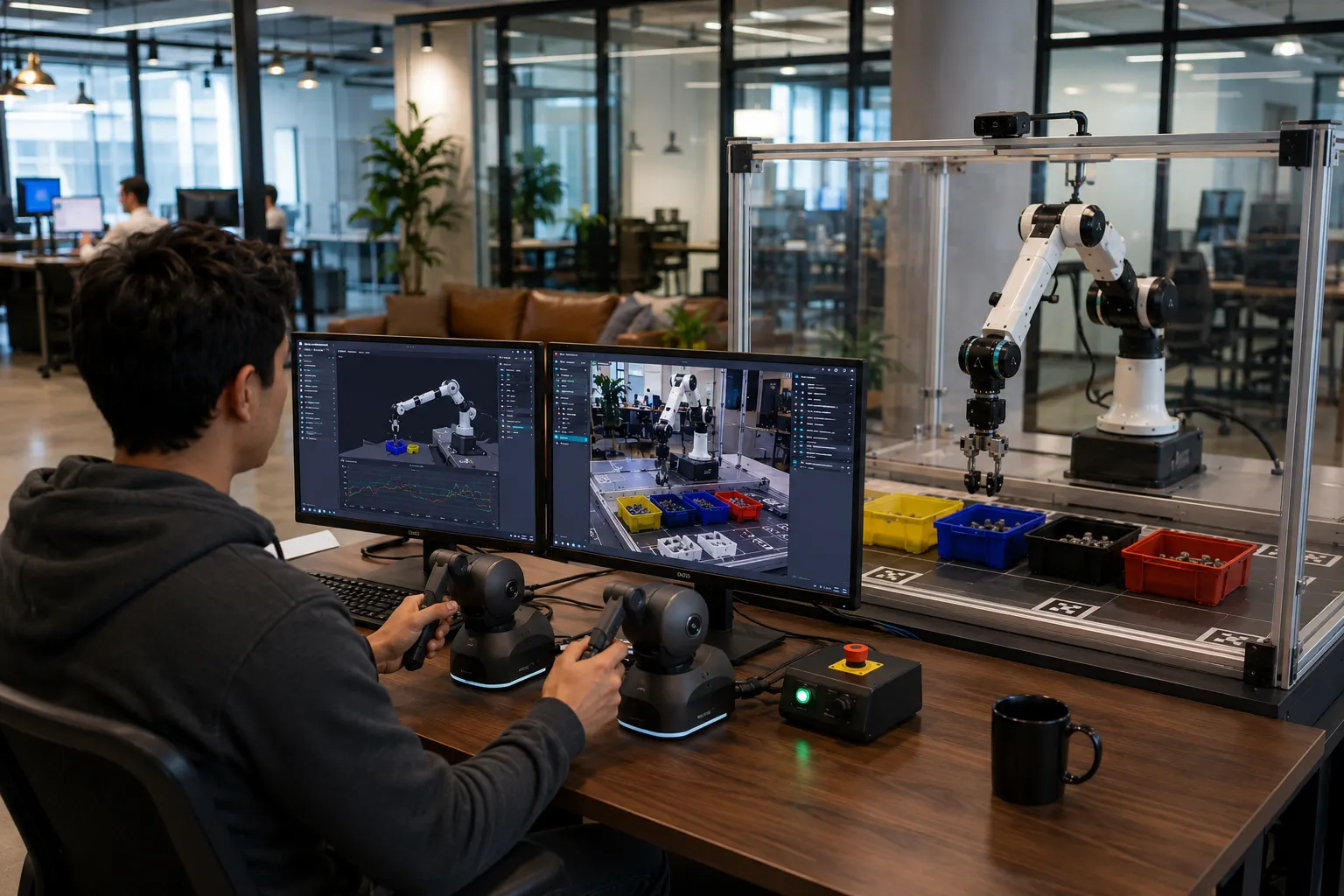
Explore before you commission
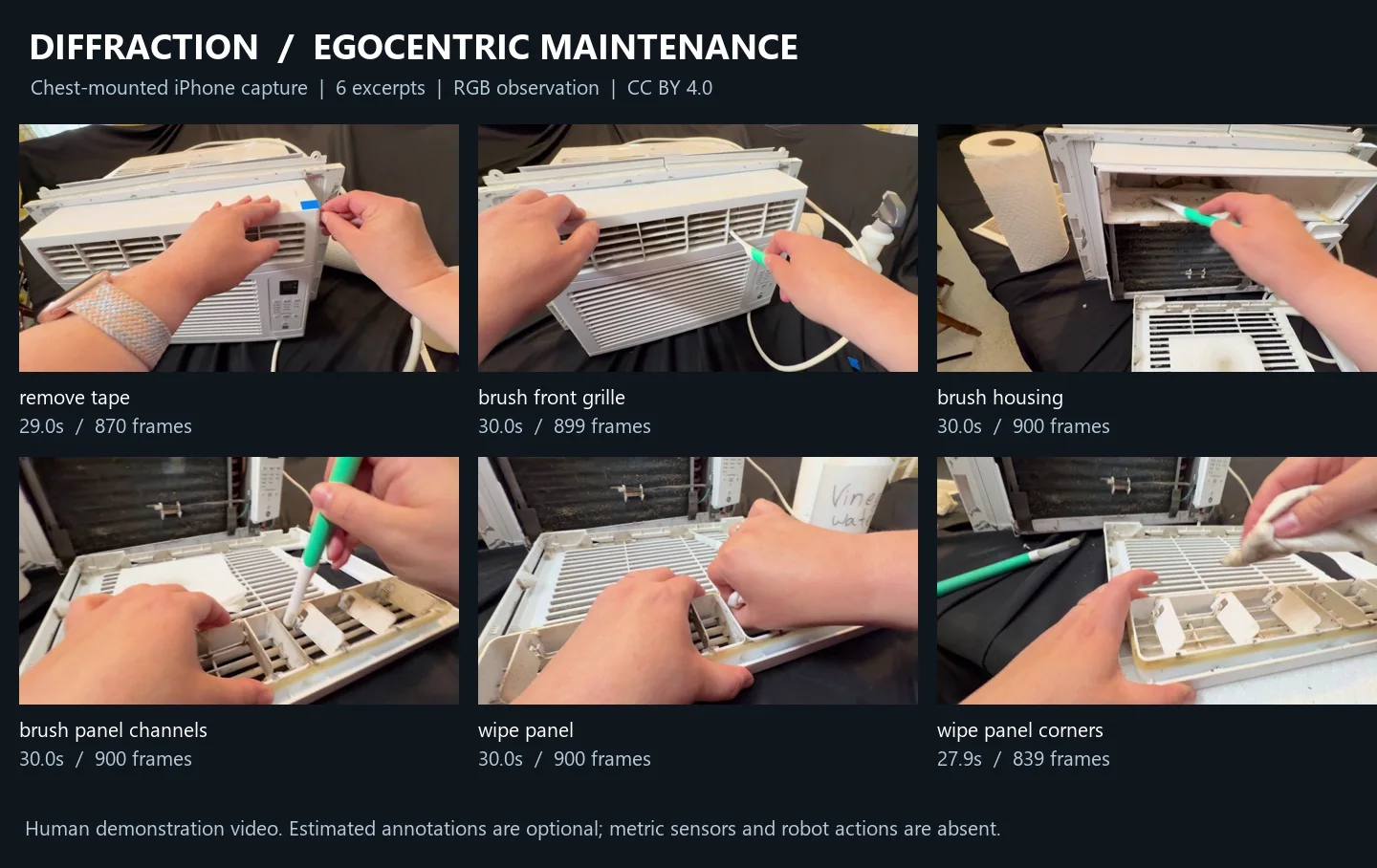 RGB · Maintenance
Public sample · CC BY 4.0
Tape removal, brushing and wiping from a chest-mounted view. Six excerpts with source-frame mapping and approximate action intervals.
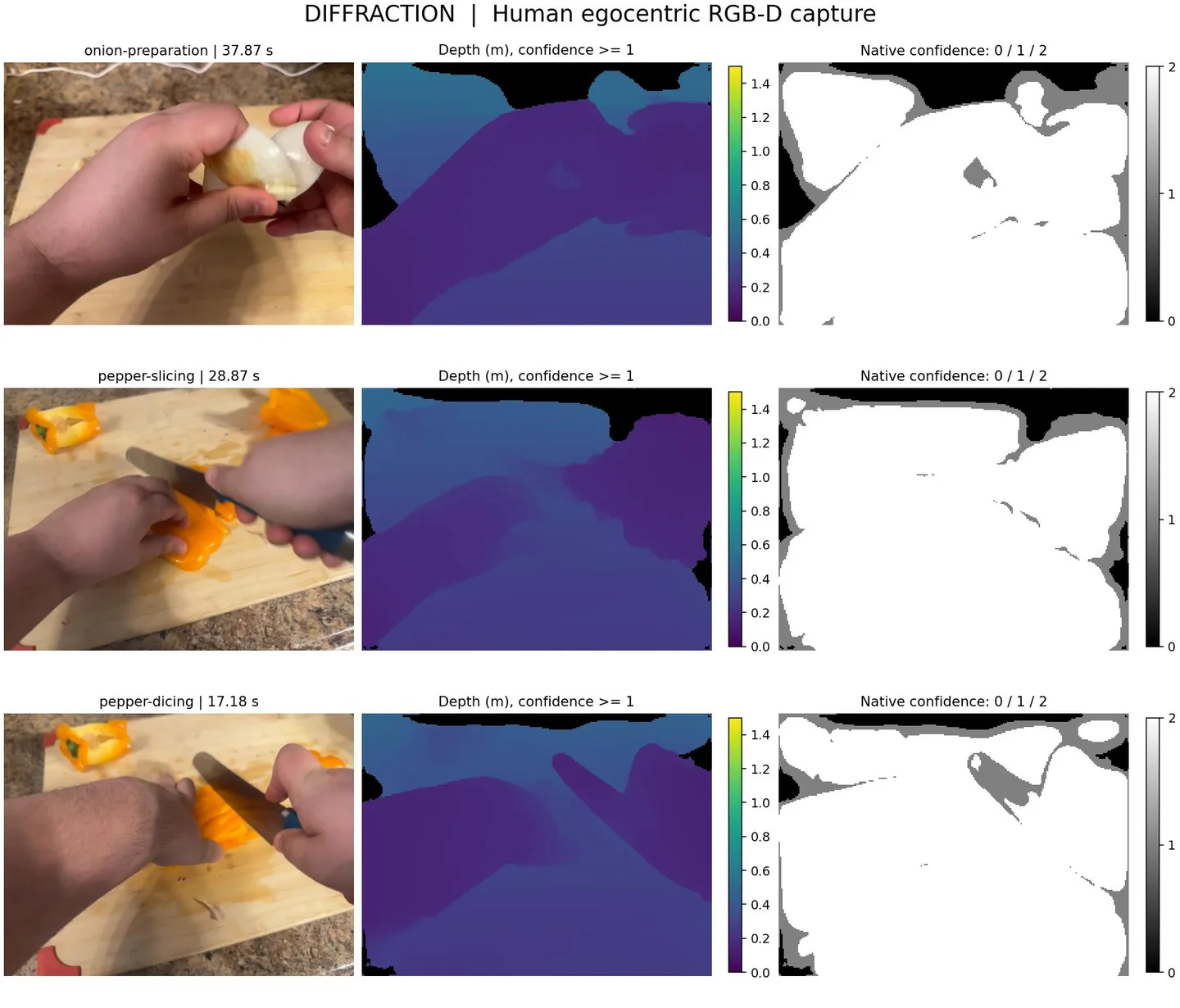 RGB-D · Kitchen
Public sample · CC BY 4.0
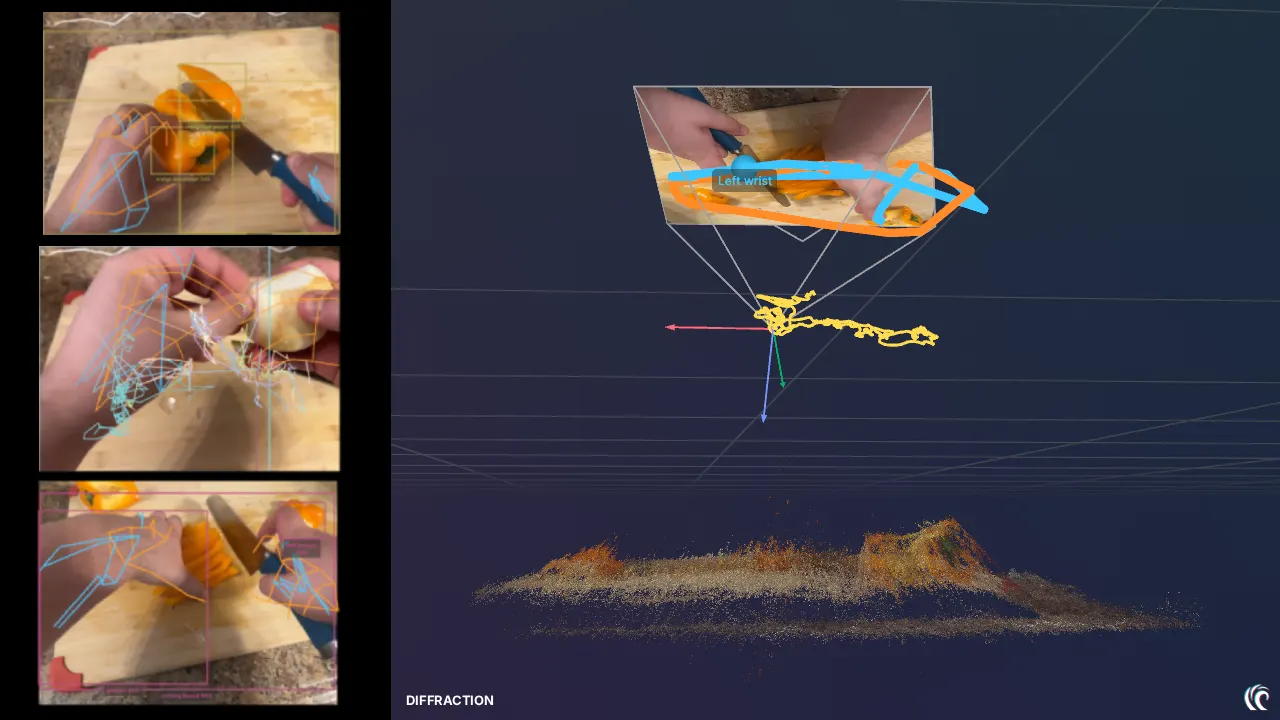
Onion preparation, pepper slicing and dicing. Three recordings with native RGB-D, device sensors and estimated annotations.
Field guide · Free brief template
Turn what you learn from the samples into tasks, signals and acceptance criteria.
Specify the tasks, environments, participant profile, camera views, required signals, acceptance criteria, and training format. Diffraction uses that brief to scope capture, processing, QA, and delivery. Identify which signals must be measured and which estimates your pipeline can accept.
Read the guide and download a dataset briefPOD capture suits tasks that need a repeatable environment and controlled camera placement. Distributed capture adds variation across homes, workshops, and everyday settings. The task, measurement requirements, and environment coverage determine which approach to scope.
Deliveries can include source video, synchronized views, QA results, dataset cards, licensing, and provenance. WebDataset, RLDS, and LeRobot/GR00T-compatible layouts are scoped to your stack. Depth, pose, IMU, and action channels depend on the hardware and brief; measured and estimated signals are declared separately.
The Operators Lab is the community route for people interested in capture and applied AI projects. Project fit depends on demand, location, skills, and equipment. Robot-arm collection is in pilot buildout, and joining the early list does not guarantee paid work.
Explore the Operators Lab and paid capture trackTell us the task, embodiment, environments, viewpoints, signals, and format you need—or start with the model failure you are trying to fix.